Garbage In, Precision Out: What My 6-Year-Old's Game Taught Me About AI Development Success
A few months ago, my son—then six years old—shipped a working 2D platformer. Multiple levels. Enemy mechanics. Unlock progression. Functional software, tested and ready to play.
He used SAMUEL, an open source AI development framework my co-founder built. The same framework I used to build this blog. The same type of AI coding assistant available to any development team.
What made the difference wasn't technical skill. It was something simpler and harder to fake: he knew exactly what he wanted to build.
AI-Generated Code Is a Mirror
Here's what I watched happen: my son pulled out his notebook and drew what he wanted. Simple sketches. A player character. Platforms. Enemies appearing on level 8.
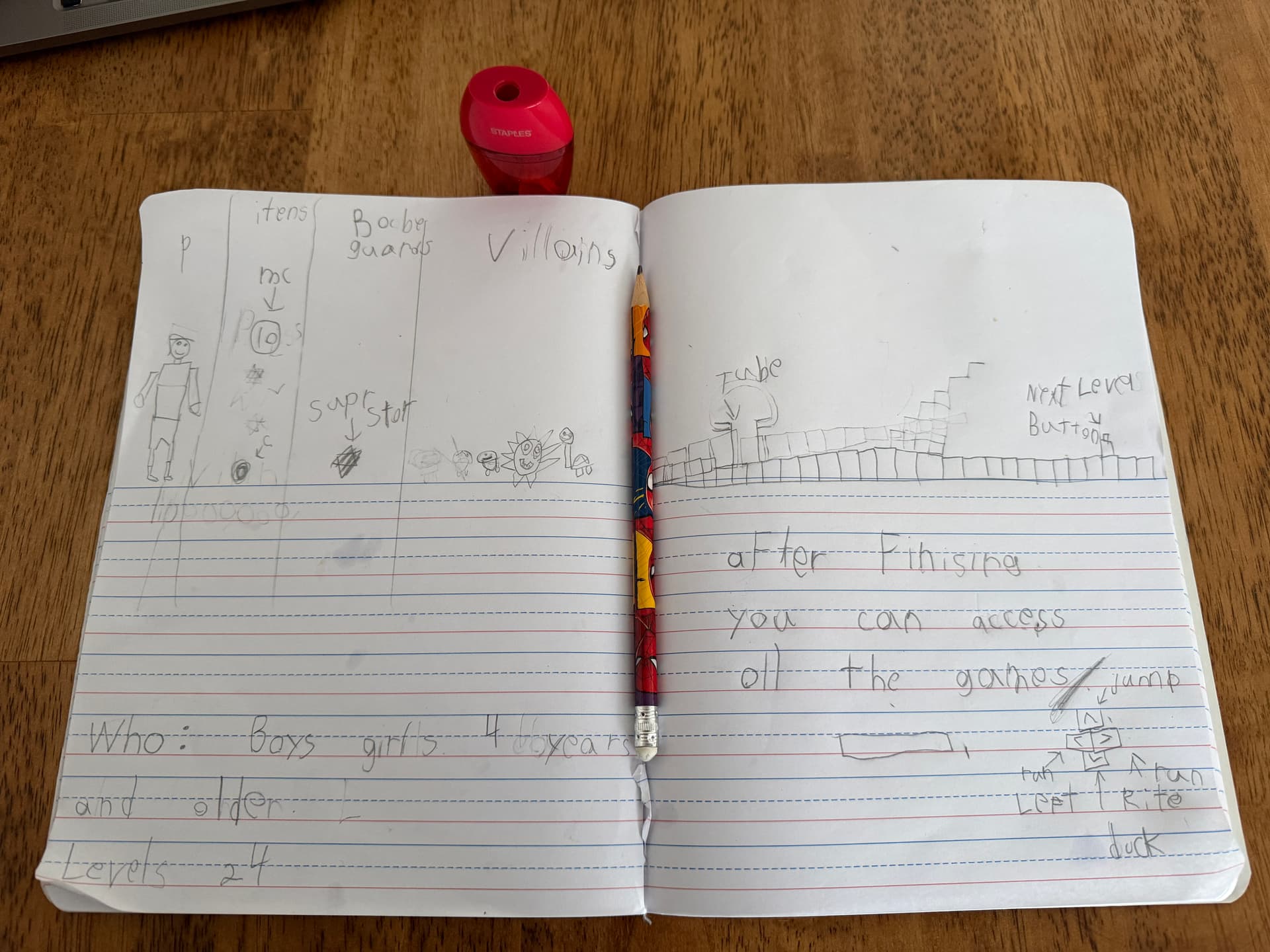
Not wireframes. Not user stories. Just clear drawings of exactly what he envisioned.
Then he described each piece to the AI framework. "I need a player that jumps when I press space." "The monster should appear on level 8." "Passing a level unlocks the next one."
Every requirement was testable. Every outcome was binary—it either worked or it didn't.
The AI built exactly what he described. Not because the framework was sophisticated, but because his requirements were clear.
This is the fundamental principle: AI-generated code is a direct reflection of your understanding of what you're building. The model doesn't compensate for ambiguous requirements. It mirrors them back with perfect fidelity.
Garbage in, precision out. Or in most cases: vague in, vague out.
What Prevents Stalling: Requirements That Survive Implementation
The most common AI development bottleneck isn't technical capability. It's requirements that sound specific in planning but collapse under implementation pressure.
"Improve customer service" sounds like a goal, but it doesn't tell you what to build. "Reduce average response time to under 2 minutes" is measurable but still doesn't define the solution. "Automatically categorize incoming support tickets by urgency and route to appropriate team members" is something you can actually implement and test.
The difference between these three statements is the difference between rapid iteration and stalled development cycles.
A six-year-old understands this instinctively. He can't build "a fun game." He can build "a player that jumps over platforms and stomps on enemies."
The specificity gap between those two statements is where development momentum gets lost.
What the Notebook Revealed About Clear Requirements
My son's notebook drawings weren't beautiful. They were functional. Each sketch answered specific questions:
- What does the player look like?
- How do platforms appear on screen?
- Where do enemies show up?
- What happens when you win a level?
No feature creep. No "maybe we could also add..." Just the minimum viable product, defined with enough precision that the AI framework could build it.
(Want to learn exactly how we shipped that 2D game? I've written a step-by-step guide—new post coming soon.)
The Framework: How We Actually Built It
We used SAMUEL, an open source framework my co-founder built with customizable guardrails for AI-assisted development. It works with any coding assistant—Claude, ChatGPT, or others—but the framework itself isn't the magic.
The magic is that it forces you to think through structure before you start building. The guardrails are codified domain knowledge. Define what you want, describe it precisely, test what you get, iterate based on results.
I built this blog using the same framework. Same process. Same discipline.
The framework works because it operationalizes requirements clarity. When you can't articulate what you want clearly enough for the framework to implement it, that's not a tool limitation—that's feedback about your requirements.
How to Prevent the Vague-In, Vague-Out Cycle
Traditional software development had built-in buffers for unclear thinking. Human developers ask clarifying questions. They push back on ambiguous requirements. They fill in gaps based on experience.
AI doesn't do that. When requirements are ambiguous, AI fills gaps based on common patterns and statistical likelihood—not your specific business logic. You get something that works generically but doesn't match your actual needs.
This compression of the feedback loop is actually valuable—if you use it correctly. Instead of discovering your requirements problems months into development, you discover them in the first iteration.
The key is recognizing what this reveals: when AI outputs don't match your expectations, the gap is usually in how clearly you've articulated your domain knowledge.
This means you can accelerate development by front-loading three things:
1. Testable Success Criteria Not "the feature should be intuitive" but "users can complete task X in under 3 clicks." Not "improve performance" but "page load under 2 seconds on 4G connection."
If you can't test whether it worked, your requirement isn't ready for implementation.
2. Domain Knowledge Articulation AI can't access what you know about your business logic unless you articulate it explicitly. The clearer you are about how your process actually works—not how you wish it worked or how it theoretically should work—the better the AI-generated solution.
My son knew exactly how his game should behave because he'd played dozens of platformers. That domain knowledge translated directly into clear requirements.
3. Iterative Validation Build the smallest testable piece first. Test it. Learn from the gap between what you asked for and what you got. Refine your understanding. Build the next piece.
My son tested after every change. When the monster didn't defeat properly, he knew immediately because he tested the moment it was added. This prevented the "everything is broken and we don't know why" death spiral.
What Success Looks Like
When you get requirements clarity right, AI development becomes systematic and predictable.
Teams achieving rapid iteration cycles with AI share common patterns:
- They define success with testable precision before writing prompts
- They articulate their domain knowledge explicitly in requirements
- They recognize gaps in their understanding early through iterative testing
- They validate with working software, not specification documents
These are operational capabilities that scale across projects and use cases. They're also skills that can be developed deliberately rather than discovered through painful iteration.
The bottleneck isn't technical capability. It's organizational clarity about what you're actually trying to build.
The Clarity Advantage
AI isn't making technical expertise obsolete. It's making requirements discipline mandatory—and visible.
The good news: this is a learnable, implementable skill. Success doesn't require ML expertise or advanced prompt engineering. It requires the same discipline a six-year-old uses to explain a video game.
When you can describe what you want with testable precision, you're ready to build with AI. Until then, you're not fighting a technical problem. You're fighting an unclear thinking problem.
The model will build what you describe. Make sure you know what that is.
Building AI-native operations through requirements discipline and operational frameworks. Available for speaking engagements and consulting on structured AI adoption. Contact me for feedback, questions, or to discuss how these frameworks might apply to your organization.